
How the main casino games actually work
Slots, blackjack, roulette and baccarat cover most of what you'll find at any of the operators in our comparison. Here's the mechanics of each, without the jargon left unexplained.
Every game below runs on either a certified random number generator (for slots and digital table games) or a physical shuffle and deal captured on camera for a live dealer (for live tables). Independent testing labs audit both approaches before a UK-licensed operator can offer them, which is a separate check from the licence itself — a fact worth knowing if a game's fairness is ever in question.
Slots
A slot spins a set of reels and pays out based on matching symbols landing on active paylines, or increasingly on "ways to win" systems that drop the fixed-line structure entirely. Three concepts matter more than any other: volatility (how often a game pays small amounts versus rare large ones), return to player, or RTP (the theoretical percentage of stakes returned to players over a very large number of spins, not a guarantee for any single session), and bonus features such as free spins or multiplier rounds that vary the base game's rhythm.
Blackjack
The goal is to get a hand value closer to 21 than the dealer without going over. Number cards count at face value, face cards count as ten, and an ace counts as either one or eleven, whichever helps the hand more. Basic strategy — a fixed set of decisions for every combination of player hand and dealer up-card — narrows the house edge to one of the smallest of any casino game when followed correctly, which is why it's often recommended as a starting point before anything more advanced.
Roulette
A wheel with numbered pockets (36 numbers plus a zero in European roulette, or an additional double-zero in the American version) spins while a ball is released; where it lands determines the winning number. Bets range from a single number at long odds to broader groups like red/black or odd/even at closer to even money. European roulette's single zero gives a lower house edge than the American double-zero version, which is worth knowing if a site offers both.
Baccarat
Two hands — the Player and the Banker — are dealt, and you bet on which will finish closer to nine, with tens and face cards counting as zero. The rules for whether a third card is drawn follow a fixed table rather than any decision by the player, which makes baccarat one of the simplest games to follow despite its reputation for being a "sophisticated" one. The Banker bet carries a slightly lower house edge than the Player bet once the standard commission on Banker wins is accounted for.
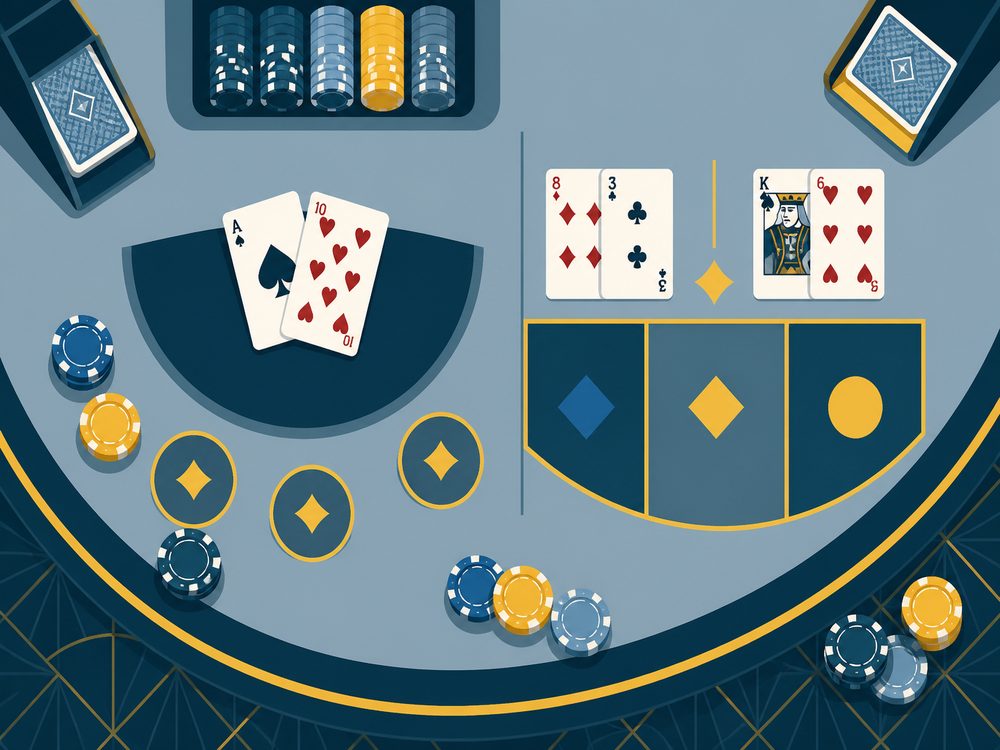
Live casino: the same games, a human dealer
Live casino takes blackjack, roulette and baccarat and streams them from a studio with a real dealer, real cards and, for roulette, a physical wheel — the software layer just handles your bets and the video feed rather than generating outcomes itself. It suits players who want the pacing and presence of a physical casino without leaving home, though tables often carry higher minimum stakes than their fully digital equivalents, and popular tables can fill up at busy times.

A note on odds, not outcomes
Every game described here has a built-in house edge — the mathematical advantage that funds the operator's business over the long run. Understanding a game's mechanics helps you play with clearer expectations, but it doesn't change that edge, and no amount of strategy turns a casino game into a reliable source of income. See our Myths & Misconceptions page for more on where this gets misunderstood, and our Responsible Gambling page for tools that help keep play in the entertainment category it's meant for.